

Callspec + Fern
Callspec + Fern
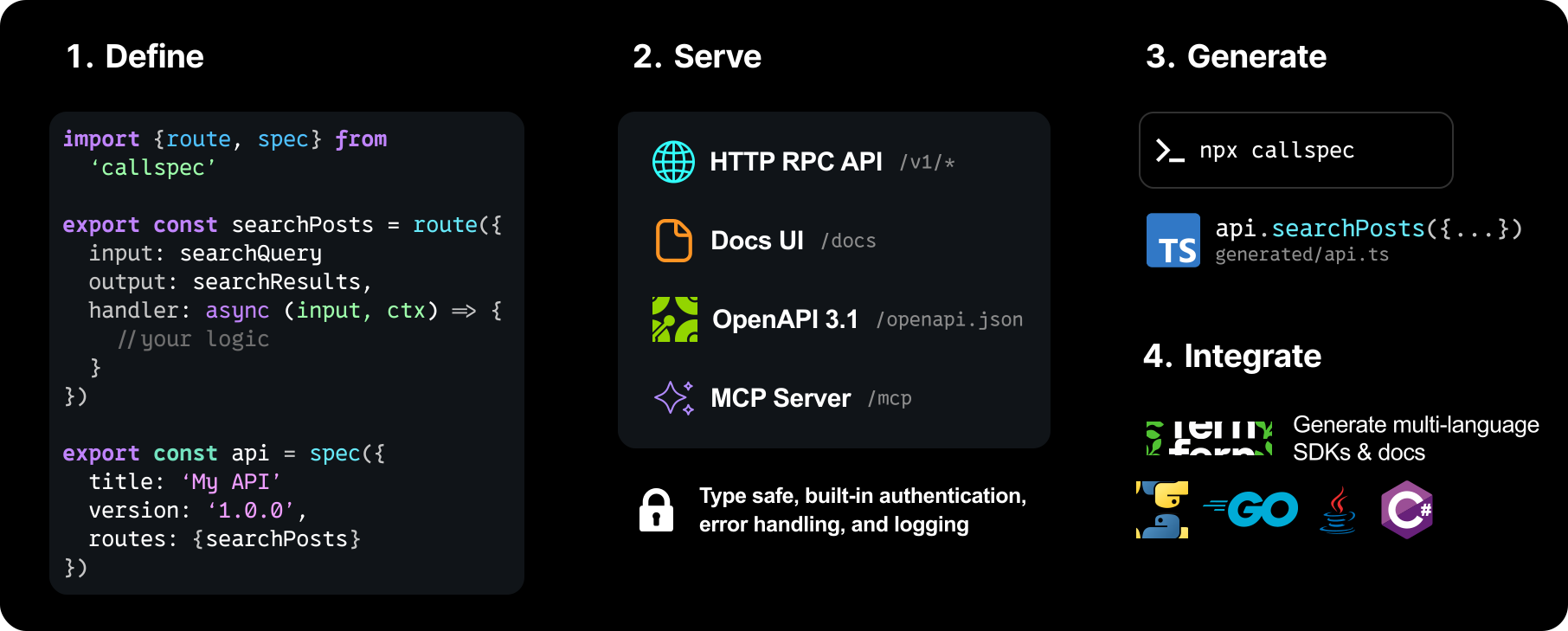
Section titled “Callspec + Fern”Callspec is your TypeScript runtime — server, integrated TS SDK, in-process MCP, docs, and /openapi.json from one route() registry. Fern is an optional public DX layer — multi-language SDKs and hosted docs for external developers.
They are synergistic, not either/or. Typical flow: mountSpec serves your API → export /openapi.json → Fern generates public SDKs and docs. Keep Callspec for everything TypeScript; add Fern when external, multi-language DX is worth a hosted account.
The overlap is small: docs, nominally TypeScript clients, and a surface-level MCP label — but each pair does different work (see below). Everything composes cleanly.
How they compare
Section titled “How they compare”| Callspec | Fern | |
|---|---|---|
| Job | Run the API in TypeScript; ship TS client, MCP, contracts | Public developer adoption — SDKs + docs in many languages |
| Source of truth | Live TypeScript + runtyp | OpenAPI / Fern Definition (from Callspec’s /openapi.json or elsewhere) |
| Server | mountSpec is the runtime | Does not replace your server |
| TS client | Generated from callspec.json — Result-typed, exhaustive errors, NETWORK_ERROR, shared runtyp validators | Can emit TS from OpenAPI — idiomatic HTTP client, not callspec-native |
| Multi-lang SDKs | Fern’s job (via /openapi.json) | Core product (Python, Go, Java, C#, …) |
| MCP | API tools — in-process /mcp; same resolvers, auth, validation as RPC | Docs MCP — hosted on Fern docs site; agents query documentation (Ask Fern), not your live API |
| Docs | Built-in /docs — fast, white-label, good for internal and many product cases | Enterprise public docs — localization, deep customization, Postman-scale polish |
| Cost / account | MIT — fully open source, self-hosted, no account | Hosted platform — account required; hobby tier available; paid for production-grade public DX |
Fern (acquired by Postman, Jan 2026) targets teams that need external developers to succeed in many languages. Callspec targets full-stack TypeScript teams that want one registry for server, browser SDK, agents, and contract — without leaving TypeScript.
Licensing & hosting
Section titled “Licensing & hosting”Callspec is MIT-licensed and runs entirely on your infrastructure. npm i callspec, mountSpec, docs UI, MCP, CLI codegen — no vendor account, no hosted control plane, no usage gates.
Fern is open-core (Apache-licensed CLI and generators on GitHub) but the product is a hosted docs + SDK platform. You sign up, connect a repo or spec, and use Fern’s cloud to build and host public docs and publish SDKs. A hobby tier exists, but you still need a Fern account; serious public-DX features (custom domains, auth, team workflows, enterprise polish) are paid.
That difference matters most for internal APIs and early products: Callspec gives you the full stack on day one with zero vendor lock-in. Add Fern later when public, multi-language DX is worth the hosted investment.
Callspec docs work well for a lot of teams — especially internal APIs, small product surfaces, and simple public docs you control (meta branding, try-it RPC, MCP connect). Override docsPath or whitelabel via meta.
Fern is the better fit when public docs are the product — large external developer programs, multilingual doc sites, heavy layout/branding customization, and the polish expectations that come with Postman-scale public DX.
You can run both:
- Callspec
/docsfor internal (or for a lightweight product explorer) + Fern for the public site fed from the same/openapi.json. - Fern only and turn off Callspec docs with
{docs: false}. Or turn it off just forproduction.
There is no requirement to pick one doc stack. Teams that adopt Fern still keep Callspec as the runtime and contract source.
TypeScript SDK
Section titled “TypeScript SDK”Both can produce a TypeScript client. Use Callspec’s for your app — it is generated from callspec.json, not generic OpenAPI, and is tightly integrated with the rest of the stack:
Callspec ApiClient | Fern (or other OpenAPI) TS SDK | |
|---|---|---|
| Error model | Result — { ok, value } or { ok: false, code, … }; exhaustive code union per method | Typical throw / HTTP status patterns from OpenAPI |
| Domain errors | Same codes as server, MCP, and docs — switch is exhaustive | Mapped from HTTP; no callspec error contract |
| Client-only errors | NETWORK_ERROR, UNKNOWN_ERROR built in | Varies by generator |
| Validation sharing | Same runtyp preds via exports + --validators for forms | Not part of the product |
| Integration | One registry → server, SDK, MCP, docs stay in sync | Consumer of /openapi.json; parallel surface |
Fern’s Python/Go/Java SDKs (and any TS SDK they emit) are best for external developers. They will not get Result-typed domain errors, shared form validators, or the same codegen loop as your frontend. That is by design — OpenAPI cannot carry the full callspec contract.
Typical split: npx callspec for your TypeScript app; Fern for every other language (and optional public docs).
Both mention MCP, but they solve different agent problems.
Callspec MCP — call your API
Section titled “Callspec MCP — call your API”mountSpec serves /mcp on the same process as your RPC server. Routes with mcp: true become MCP tools that invoke the same resolvers as HTTP — same Bearer auth, runtyp validation, and error codes. Connect from the built-in docs UI; no separate doc product required.
This is for agents that need to execute your API (create resources, run queries, etc.) with production auth and validation.
Fern MCP — query your public docs
Section titled “Fern MCP — query your public docs”Fern auto-hosts an MCP server on Fern docs sites (with Ask Fern enabled) at:
https://your-docs-site.com/_mcp/serverThat server exposes your documentation to AI clients (Cursor, Claude Code, Windsurf, …) as a live data source — essentially Ask Fern search over your docs, not tools/call against your running API. Agents get answers about your product from the doc site; they do not hit your Callspec server through this path.
Separate surface: Fern docs MCP requires a Fern-hosted docs site. It is configured in Fern (docs.yml; set page-actions.options.mcp: false to disable). Authenticated doc sites need a FERN_TOKEN JWT on the MCP client — separate from your API’s Bearer auth.
Fern also ships llms.txt and per-page Markdown as non-MCP ways for agents to read docs.
API-tool MCP from Fern (early)
Section titled “API-tool MCP from Fern (early)”Fern is working on a TypeScript MCP server generator that would expose generated SDK methods as MCP tools in a standalone server — OpenAPI/SDK-shaped, not colocated with mountSpec. That is not the same as Callspec’s in-process tools and would not carry callspec’s Result contract, shared validators, or authenticate hook. Treat it as early / separate if you evaluate it.
Do not confuse Fern docs MCP with the Postman MCP server (Postman collections, workspaces, code-gen context) — another product in the Postman family after the Fern acquisition.
Using both
Section titled “Using both”| Need | Use |
|---|---|
| Agents call your API with real auth | Callspec /mcp |
| Agents search public docs / Ask Fern | Fern /_mcp/server on your doc site |
| Internal agents + internal docs | Callspec docs + Callspec MCP — often enough alone |
| Public docs at Fern scale + API tools | Fern public docs MCP + Callspec MCP on the API |
No either/or. Most teams that add Fern for public DX still run Callspec MCP on the server for live API access.
Typical stack
Section titled “Typical stack”Callspec owns TypeScript end-to-end; Fern consumes the OpenAPI export for public multi-lang DX:
# Callspec serves the API and contractcurl -fsS http://127.0.0.1:3000/v1/openapi.json -o openapi.json
# Fern for public SDKs + public docs (optional)fern init --openapi ./openapi.jsonfern add fern-python-sdk   # Go, Java, Ruby, C#, …fern generate
Your TypeScript app keeps the Callspec-generated ApiClient (npx callspec …). External developers get Fern SDKs (other languages + optional public docs) from the same API.
When to add Fern
Section titled “When to add Fern”Consider Fern when you need public DX Callspec does not optimize for:
- Idiomatic SDKs in languages beyond TypeScript
- Public doc sites with localization and deep customization
- Enterprise external-developer programs (onboarding, versioning, hosted docs at scale)
Skip Fern when TypeScript + Callspec docs + /openapi.json for gateways and tooling is enough — common for internal platforms and many product APIs.
Summary
Section titled “Summary”- Callspec — MIT, self-hosted, no account; integrated TS SDK, in-process API MCP, internal-friendly docs.
- Fern — hosted public DX (account required; hobby + paid tiers); multi-language SDKs and public docs.
- Together —
mountSpec→/openapi.json→ Fern; keep or disable Callspec docs as you prefer.
Not competitors. Composable layers.